Forex Mentor Miami: FOMC April 2026 — The Most Divided Fed Vote Since 1992, Powell’s Final Meeting, and What the Dollar Surge Means for Your Prop-Firm Trades
If you’re searching for a Forex Mentor Miami, a real Forex Trading Course Miami, or a legit Forex Trading Mentor in Miami who explains macro events — not just “buy here, sell there” — this post is for you.
At Miami Trading Academy, we drill one core concept above all others: macro context drives price action. You cannot understand your EURUSD chart without understanding what happened at 2:00 PM ET on April 29, 2026 — the day of the FOMC meeting that produced the most divided Fed vote in over 33 years.
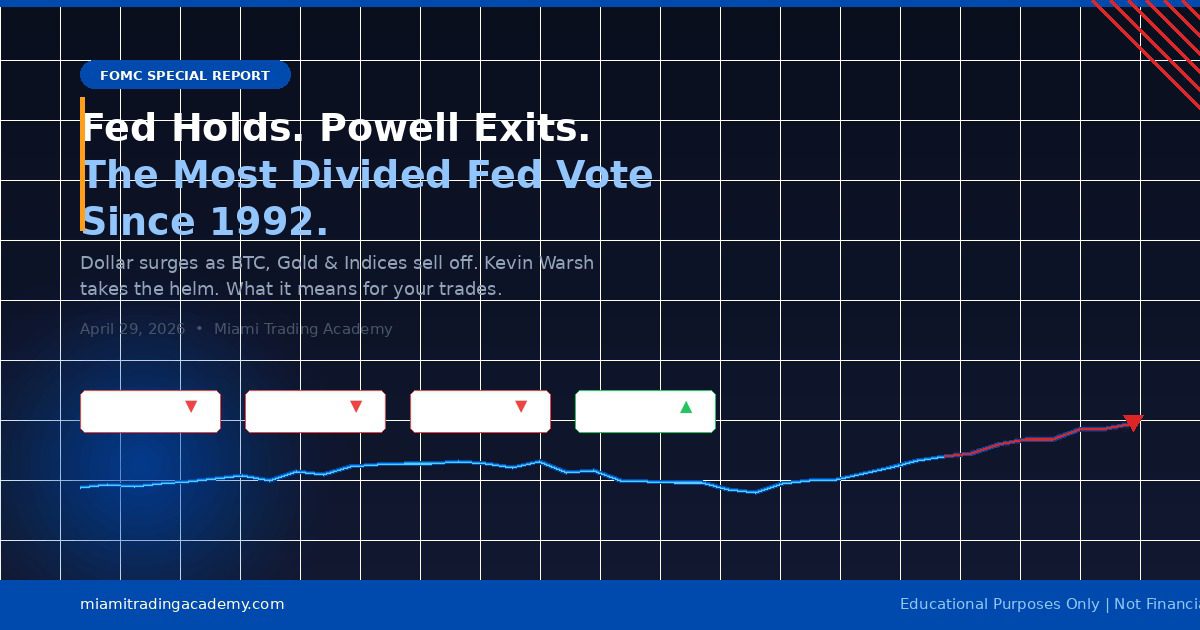
Today we break down everything: the 8–4 split vote, the initial dollar strength, the selloffs in Bitcoin, Gold, and U.S. indices, Jerome Powell’s final press conference as Fed Chair, and what the arrival of Kevin Warsh means for your prop-firm trading plan going forward.

Royalty-free image (no watermark): Unsplash.
Core idea: The Fed held rates. That was expected. What wasn’t expected was an 8–4 split vote — the most divided FOMC in over three decades — that sent the dollar surging and risk assets selling off hard.
Understanding why this happened is what separates a disciplined prop-firm trader from someone just watching candles.
The Headline Verdict: Hold at 3.5%–3.75% — But Nothing Else Was “Normal”
Markets had priced in a 100% probability of no rate change coming into today’s FOMC meeting. On that front, the Fed delivered exactly what was expected: the federal funds rate stays anchored in the 3.50%–3.75% target range for a third consecutive meeting. What was not expected was everything surrounding that decision.
The Fed’s official statement acknowledged that economic activity is still expanding at a solid pace, but job gains have remained subdued and inflation stays elevated at 3.3% year-over-year — the highest annual print since May 2024. Oil above $100 a barrel, driven by the ongoing U.S.-Iran conflict and the Strait of Hormuz closure, is the primary inflation wildfire the Fed is watching right now.
Trader translation: The rate held. But the vote structure, the statement language, and the press conference created real volatility signals. Within minutes of the announcement, the dollar bid, Bitcoin dropped below $77,000, Gold fell to a three-week low under $4,560, and the Dow sold off 300 points.
The Historic 8–4 Split Vote: The Most Divided Fed Since October 1992
This is the story of today’s meeting. Four FOMC members dissented — producing the most internally divided Fed vote in over 33 years. The last time the FOMC had four dissents was in October 1992. In a term generally marked by consensus building, Chair Powell concluded his tenure with four dissenters at the table.
What makes this split especially significant is that the four dissenters didn’t all want the same thing — making incoming Chair Kevin Warsh’s job considerably harder from Day 1:
| Dissenting Member | Role | What They Wanted | Why It Matters |
|---|---|---|---|
| Stephen Miran | Fed Governor | Cut rates by 25 bps — wanted immediate easing | Has dissented at every meeting since joining in September. The lone dove. No surprise here. |
| Beth Hammack | President, Cleveland Fed | Remove the easing bias from the statement | Hawks don’t want language implying future cuts are coming. With CPI at 3.3%, they see inflation as the dominant risk. |
| Neel Kashkari | President, Minneapolis Fed | Remove the easing bias from the statement | The phrase about “extent and timing of additional adjustments” reads as a dovish lean the hawks reject entirely. |
| Lorie Logan | President, Dallas Fed | Remove the easing bias from the statement | With oil above $100 and CPI running hot, Logan sees real upside inflation risk — no room for a dovish signal. |
What this means for markets: Three regional Fed presidents (hawks) essentially sent a warning shot to incoming Chair Kevin Warsh: “Don’t come in here and cut rates while inflation is still running hot.” One governor (Miran) wants cuts. The new chair walks into a deeply divided house on Day 1.
The power of the FOMC Chair is the power of persuasion — and right now, that persuasion job looks very difficult.
The immediate market signal: In the minutes following the FOMC announcement, traders shifted their probability for a rate hike in 2026 from 0% to as high as 25% — a dramatic repricing that reflected the hawkish tone of the dissents. That kind of shift in the rate path is exactly what moves EURUSD, BTCUSD, and Gold in a hurry.
Initial Market Reaction: Dollar Surges, Bitcoin Sells Off, Gold Drops, Indices Lower
The initial reaction across all major markets was clear and consistent: dollar strength, risk-asset weakness. Here’s the snapshot of how each major asset responded to the most divided Fed vote in a generation:
| Asset | Reaction | What Drove It | Trader Implication |
|---|---|---|---|
| DXY (Dollar Index) | ▲ Bid / Strengthening | Three hawks removing the easing bias + rate hike probability jumping to 9–25% | Near-term dollar tailwind. EURUSD bears have the macro backdrop on their side. |
| EURUSD | ▼ Pressure | Dollar bid directly weighs on the pair. ECB-Fed divergence narrative strengthens. | Watch 1.1775–1.1780 support as the first real test. Lose it = deeper pullback scenario. |
| Bitcoin (BTCUSD) | ▼ Below $77,000 | Dollar strength + rate hike probability repricing = risk-off for speculative assets | Classic “sell the news” + hawkish surprise combo. BTC down from $79,486 weekly high. |
| Gold (XAUUSD) | ▼ Below $4,560 (3-wk low) | Dollar bid outweighs geopolitical safe-haven demand. Rate hike probability reduces gold appeal. | Short-term headwind despite long-term structural support from central bank buying (863t in 2025). |
| Dow Jones (DJIA) | ▼ –300 pts (–0.6%) to 48,861 | Hawkish dissent signals higher-for-longer rates. Rate-sensitive sectors sold first. | Risk-off macro environment. 10-yr Treasury yield climbed toward 4.41%. |
| S&P 500 | ▼ –0.04% to 7,135 | Modest decline — tech earnings provided some offset. Broad market felt the hawkish surprise. | Watch for continued pressure if rate hike probability continues rising in May data prints. |
Correlation warning for prop-firm traders: When the dollar bids hard on hawkish Fed news, the risk-off trades correlate quickly: Gold down, BTC down, indices down, EURUSD down. If you hold short EURUSD + short Gold + short BTC simultaneously, you’re not diversified — you’re tripling your dollar-long exposure. Know your correlation. Size accordingly. One trade at a time in a macro environment this synchronized.
Powell’s Final Press Conference as Fed Chair: “This Is My Last Press Conference as Chair”
Jerome Powell’s term as Federal Reserve Chairman ends on May 15, 2026. Today was — in all likelihood — his final press conference in that role. And in true Powell fashion, he used it to address three things: central bank independence, the transition to Warsh, and his own surprising future.
Powell Stays — As a Governor
The biggest surprise from today’s press conference wasn’t the rate decision. It was Powell announcing he will remain on the Fed’s Board of Governors rather than departing entirely. Powell said he is waiting until the investigation into the Federal Reserve’s building renovation project is “well and truly over with transparency and finality.”
This has a real structural consequence: Kevin Warsh will not inherit Powell’s board seat. Instead, Warsh takes the seat vacated by Stephen Miran (whose term expired January 31, 2026). The balance of power between hawks and doves does not automatically shift the way many expected. Warsh adds one seat, but Powell stays — a historically unusual dynamic heading into June’s first Warsh-chaired meeting.
Powell also defended Fed independence forcefully, noting the central bank has had to use the courts to push back against political interference: “We’ve been successful so far. But that’s not over.” He called the transition to Warsh “a very normal, standard kind of process” and congratulated Warsh on his Senate Banking Committee advancement.
| Powell’s Tenure — At a Glance | Detail |
|---|---|
| Term as Chair | February 5, 2018 – May 15, 2026 |
| Landmark policy actions | COVID-era QE (2020), historic rate hike cycle (2022–2023), rate cuts (2024–2025), holds (2026) |
| Final federal funds rate | 3.50%–3.75% (as of May 2026) |
| Final vote as Chair | 8–4 split — most divided since October 1992 |
| Post-Chair role | Remains on Fed Board of Governors (indefinitely) |
| DOJ investigation | Dropped. OIG investigation (building renovation) still ongoing — reason Powell is staying. |
Kevin Warsh: Your New Fed Chair — And What It Means for Forex Traders
President Trump’s nominee Kevin Warsh cleared the Senate Banking Committee on a party-line vote the morning of April 29. The full Senate vote is expected within days, and Warsh is set to assume the chairmanship on or around May 15, 2026 when Powell’s term formally expires.
Warsh is a former Fed Governor (2006–2011) and Morgan Stanley investment banker. He is seen as closer to the Trump administration’s preference for lower rates — but his recent statements have been more nuanced than many expected. His Senate confirmation testimony made clear he views inflation progress as “improving but incomplete,” a phrase that triggered a single-day 2% gold selloff when it was first reported.
| Question About Warsh | What Markets Are Saying |
|---|---|
| Will he cut rates? | Some expect cuts — SoFi CEO Anthony Noto: “Greater propensity to deliver rate cuts.” But three hawks are already on record pushing back. |
| Will he be independent? | Only 50% of CNBC Fed Survey respondents believe Warsh will act mostly or very independently. High level of skepticism. |
| Communication changes? | Warsh signaled fewer press conferences: “Truth-seeking is more important than repetition.” Fewer forward-guidance signals = more volatility around remaining events. |
| First challenge? | Building consensus with a divided FOMC. Hammack, Kashkari, and Logan have already staked out hawkish ground. Day 1 is already a negotiation. |
For prop-firm traders: Warsh inherits an FOMC where the vocal hawks outnumber the dovish voices — yet Trump wants rate cuts. This persistent tension will show up as elevated volatility in EURUSD, DXY, and rate-sensitive pairs every time a Fed official speaks. Build that into your risk model: the next 60–90 days are a high-vol regime.
The Macro Backdrop That Drove Today’s Split: Oil, Iran, and Sticky Inflation
Context is everything. The reason three regional Fed presidents dissented so forcefully today isn’t random — it’s the direct product of the macro environment that’s been building since early 2026. Understanding this backdrop is essential for anyone trading EURUSD, XAUUSD, or any USD-denominated pair in the months ahead.
| Macro Factor | Current Status | Trading Implication |
|---|---|---|
| Oil Prices | WTI above $100/barrel — highest in four years. Strait of Hormuz closure (Feb 28, 2026) still rippling through energy markets. | Higher oil = higher inflation expectations = hawkish Fed bias. Every EURUSD and risk-asset move now has an oil component. |
| CPI (March 2026) | +0.9% MoM, +3.3% YoY — highest annual print since May 2024. Gas prices above $4.00/gallon. | Cuts are off the table near-term. Dollar stays supported on hawkish narrative. Gold pressured despite geopolitical demand. |
| U.S.-Iran War | Active conflict. Second round of peace talks underway. Uncertainty driving safe-haven dollar bids. | Traditional risk-off = dollar up. Ceasefire = oil crashes, CPI relief, Fed can cut, dollar weakens, EURUSD recovers fast. |
| Labor Market | Job gains remain low. Unemployment stabilizing. “Weak but not in distress” is the consensus. | Fed can’t hike aggressively into a soft labor market. But they can’t cut with 3.3% inflation. Stuck — and divided. |
| Fed Rate Path | Median dot plot still implies one cut in 2026 (September or December). Hawks want to remove even that guidance. | Watch every Fed speaker for guidance revisions. Increased vol around speeches is the new normal under Warsh. |
What Today’s FOMC Means for Prop-Firm Traders (Especially EURUSD)
At Miami Trading Academy, we teach macro context not as background noise but as the fundamental driver of your daily bias. Here’s how today’s FOMC outcome translates directly into your trading plan:
1. Dollar Strength Is the Near-Term Bias — Until Something Changes
The hawkish dissents and the repricing of rate hike probability give the dollar a near-term tailwind. For EURUSD, the path of least resistance short-term is bearish — pressure back toward the 1.1775–1.1780 support zone and potentially the 1.1718–1.1678 SMA region if dollar strength accelerates. However, one soft CPI print or an Iran ceasefire announcement could reverse this quickly. This is not a “set and forget” macro trade — it’s a “manage risk and stay alert” environment.
2. ATR-Based Stops Are Non-Negotiable in Post-FOMC Volatility
In high-volatility post-FOMC environments, ATR expands. That means fixed pip stops are now too tight. Run your ATR(14) on H1 and H4 daily to recalibrate. If ATR was 8 pips before the FOMC and is now 14 pips, your position sizes must shrink to keep the same dollar risk. This isn’t optional — it’s how you survive without blowing your drawdown on volatility spikes.
3. Warsh Transition = Higher Vol Around Every Fed Speak Event
With Warsh signaling fewer press conferences, every Fed statement and public appearance becomes higher-stakes. Less regular forward guidance means more surprise potential. Build wider ATR-based stops into your risk model for the next 60–90 days. The uncertainty premium on EURUSD, XAUUSD, and BTCUSD is going up.
4. The 30-Minute News Rule Is Survival Protocol Right Now
Between Warsh’s confirmation vote (imminent), his first FOMC meeting (June), and ongoing Iran-oil volatility, the next 6–8 weeks are going to be news-heavy. Your 30-minute pre/post news blackout rule isn’t just good practice — it’s prop-firm survival. Firms don’t care that “the Warsh confirmation vote spiked you out.” They only see the drawdown violation on your account.
Pending order discipline: Days like today are exactly why we preach pending orders over market execution. If you had a sell limit on EURUSD at the 1.1890–1.1920 resistance zone with an ATR-based stop before 2:00 PM ET, you were positioned correctly. If you were chasing price after the FOMC print — you were gambling, not trading. The plan is set before the event, not during it.
EURUSD Key Levels Post-FOMC (Updated for Dollar-Bid Backdrop)
With dollar strength as the new near-term macro narrative, your EURUSD level map shifts. Here’s how to read the key zones through the lens of today’s FOMC result:
| Level | Post-FOMC Role | What to Watch For |
|---|---|---|
| 1.1890–1.1920 | Former pivot — now resistance | Sell limit zone. A rejection here with an ATR-based stop = high-quality bearish continuation trade setup. |
| 1.1775–1.1780 | Critical support — first major test | Hold = potential buy limit zone (dip buyers vs. dollar bulls fight here). Lose it = next supports open up fast. |
| 1.1718 / 1.1678 | SMA support cluster | If EURUSD reaches here, reduce size significantly. You’re in deep dollar-bid, risk-off territory. |
| 1.1619 | 200-day SMA — structural line in the sand | Lose this on a daily close and the medium-term trend character changes entirely. Bears take over. |
| 1.2000 | Psych level — now distant upside | Only comes back into play if Iran ceasefire + soft CPI reverse the dollar bid. Watch this as the bull invalidation level short-term. |
Two-Scenario Pending Order Plan for the Post-FOMC Week
Every day at Miami Trading Academy, we write two scenarios — one bullish, one bearish — and we wait. Price will pick one. Your job is to execute the plan, not force a trade. Here’s how that looks coming out of today’s FOMC:
| Scenario | Trigger | Pending Order Type | Invalidation |
|---|---|---|---|
| Bearish (sell the bounce) | EURUSD rallies back to 1.1890–1.1920 and shows rejection (wick + H1 close back below the zone) | Sell Limit at resistance zone. ATR(14) H1 × 1.2 stop. | Clean H1 close above 1.1920. Accept you’re wrong and cancel. |
| Bullish (buy the dip) | Iran ceasefire headlines OR soft CPI print pushes dollar lower. EURUSD holds 1.1775–1.1780 with a confirmed H1 close above. | Buy Limit at support zone. ATR(14) H1 × 1.2 stop below the zone. | H1 close below 1.1775. Don’t “hope” the level holds. |
Risk per trade: 0.25% maximum. After FOMC volatility, most prop-firm traders should be at 0.10%–0.15% until ATR normalizes. The market will be there tomorrow. Your funded account is the priority — not catching every post-FOMC pip.
Upcoming Macro Events Every Trader Must Have on the Calendar
| Date / Event | What to Watch | Impact on EURUSD / Dollar |
|---|---|---|
| Imminent — Full Senate vote on Warsh | Expected to pass. Markets may re-rate Fed cut expectations on confirmation. | Confirmation = USD volatility event. Pending orders should already be set. |
| May 15, 2026 — Warsh takes over as Chair | Any early statements on rate path, communication style, or balance sheet will move markets immediately. | High vol event. Reduce size in the 48 hours before and after. |
| May CPI Release (mid-May) | If CPI stays at 3%+, the hawkish dissents were justified. Dollar bid extends. If it prints soft, relief rally in risk assets. | Most important data print of the next 30 days for EURUSD direction. |
| June FOMC — Warsh’s First Meeting | Defines 2026 Fed policy trajectory. Will Warsh signal cuts, holds, or a hawkish surprise? Markets are watching closely. | Position sizing should reflect elevated uncertainty in the weeks leading up to this meeting. |
| Iran Peace Talks (ongoing) | Ceasefire = oil crashes = CPI relief = Fed can consider cuts = dollar weakens = EURUSD bull scenario reopens. | This is the single biggest wildcard for the dollar in 2026. Always check oil and Iran headlines before the session. |
Prop-Firm Reality Check: How to Survive High-Vol Macro Events Like Today
FOMC days are where prop-firm accounts go to die. Not because the strategy is wrong — but because traders throw the strategy out the window the moment price starts moving fast. Here’s the framework that keeps you funded through events like today:
- Pre-event (30 min before 2:00 PM ET): No new entries. If you’re already in a trade with a stop set, leave it. If you’re not in a trade, don’t force one.
- Post-event (0–60 min after print): Watch, don’t trade. Let the initial spike resolve and the candles form structure before doing anything.
- ATR recalibration: After FOMC, rerun ATR(14) on H1 and H4. If volatility has doubled, your position size halves. No exceptions.
- Daily stop discipline: If you lose 2 trades in post-FOMC chop, stop for the day. The move already happened. You’re not “catching up” — you’re chasing.
- Weekly stop: If you’re down 1.5%–2% for the week after trading around the FOMC, stop and review. Never double down to recover in a volatile macro window.

Royalty-free image (no watermark): Unsplash.
Hard truth: Most prop-firm failures happen in the 48–72 hours after major macro events. Traders see the big move and increase size to “catch up.” That’s the exact wrong behavior. After FOMC prints, reduce size until volatility normalizes. ATR will tell you when the range is back to normal. Patience is the edge.
Build Your Long-Term Infrastructure: Prop Firm Payouts → Your Own Account
Today’s FOMC reinforces a truth we preach at Miami Trading Academy: macro clarity is the most valuable edge in forex trading. Knowing the Fed structure, the rate path, and the key macro risks isn’t optional background knowledge — it’s the difference between entering a trade with conviction and entering one based on noise.
The endgame isn’t just passing prop-firm challenges. It’s building a personal trading account with those payouts — one that gives you full platform freedom, full strategy flexibility, and long-term compounding power. Use prop firm payouts as your capital ladder, and build your own book on the side.
Broker spotlight: Ox Securities publishes its licensing and regulatory info in their legal documentation, including an Australian entity under an AFSL and additional regulatory disclosures. Always verify that any broker fits your jurisdiction before opening an account. Do your own due diligence.
Free 15-Minute Strategy Call — Build Your Post-FOMC Trade Plan
If today’s FOMC result left you uncertain about your EURUSD bias, your risk model, or how to navigate the Warsh transition as a prop-firm trader — that’s exactly what our free 15-minute strategy calls are for. On our call, we’ll help you:
- Update your EURUSD key level map based on the post-FOMC macro context
- Recalibrate your ATR-based stop model for the new volatility regime
- Build two-scenario pending order setups for the coming sessions (no chasing)
- Create a news-filter protocol for the Warsh confirmation and transition period
- Design a prop-firm-safe risk framework that survives high-vol macro events
Final Thoughts
The April 29, 2026 FOMC meeting will be remembered for three things: the most divided Fed vote since 1992, Powell’s quiet exit and unexpected decision to stay on as Governor, and the first day of the Warsh era. The dollar got a hawkish bid. Risk assets sold off. Rate hike probabilities went from zero to real.
For traders, the message is straightforward: the macro environment in 2026 is not one-directional and it is not calm. Oil above $100, inflation at 3.3%, a Fed in genuine internal disagreement, and a new Chair walking in — this is a high-vol regime. Your job is not to predict where the market goes. Your job is to manage risk so you survive to trade the next setup.
ATR keeps your stops realistic. Pending orders keep your emotions out of the trade. Top-down analysis keeps you trading at levels that matter. And discipline — the kind that stops for the day after two losses, that reduces size after FOMC, that doesn’t stack correlated trades — is what separates funded traders from blown accounts.
The Warsh era begins in 16 days. Trade accordingly.
Disclaimer
Trading involves substantial risk and is not suitable for everyone. Past performance is not indicative of future results. This content is for educational purposes only and does not constitute financial advice. All market data referenced is based on publicly available information as of April 29, 2026.