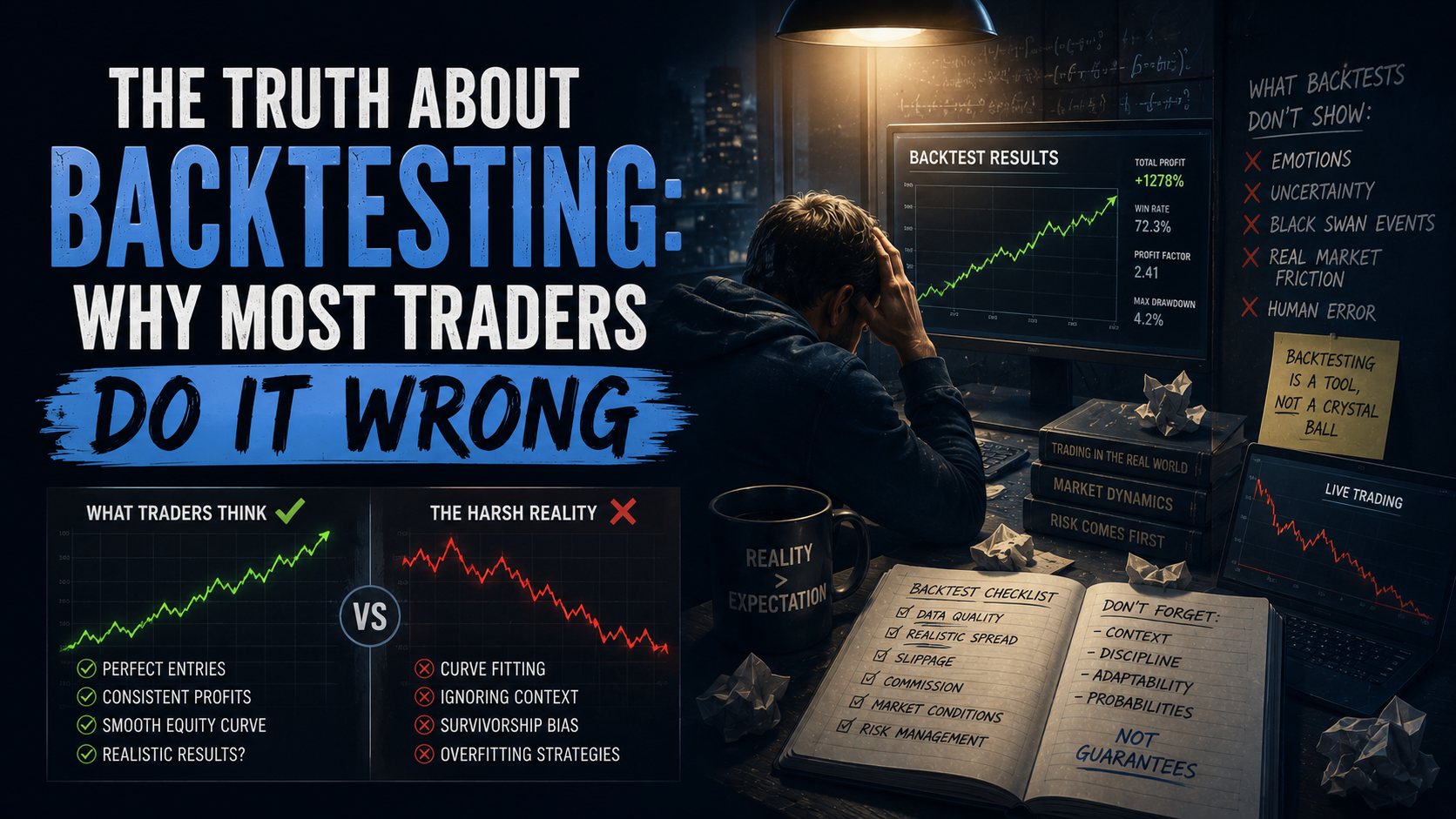
Backtesting is one of the most misunderstood parts of trading. Most beginners think running a strategy through past data automatically makes it profitable. That’s far from the truth.
Here’s why most traders backtest incorrectly — and how to do it right.
Common Backtesting Mistakes
- Curve-fitting (Over-optimizing) They tweak the strategy until it looks perfect on past data, but it fails in real time.
- Ignoring spread, slippage, and commissions They assume perfect entry/exit prices that don’t exist in live trading.
- Using too small of a sample size Testing only 3–6 months of data instead of 2–3+ years.
- Not accounting for different market conditions A strategy that worked in a strong bull market may fail in a ranging or bearish one.
- Forward-looking bias Accidentally using information that wasn’t available at the time of the trade.
How to Backtest Properly
- Test at least 2 years of data (ideally 3–5 years)
- Include realistic costs (spread + commission)
- Track win rate, risk-reward, and maximum drawdown
- Test across different market regimes (trending, ranging, high volatility)
- Keep a detailed log of every trade
Final Truth: A good backtest doesn’t prove your strategy works. It only shows it might work. The real test is forward testing (demo) for several months.